
SUPPLY CHAIN MANAGEMENT
Supply Chain Management (ORIGIN – SUPPLY CHAIN MANAGEMENT)
It is now widely recognized that effective supply chain management is a critical factor in achieving sustainable business operations and meeting organizational goals. Origin recognizes the importance of supply chain management—especially in the real estate development business, which is the Company’s core activity. This includes managing the supply chain from upstream to downstream: starting from securing suitable sources of funding, forming joint ventures and financial partnerships, and ensuring the availability of quality vendors and suppliers at appropriate cost levels to support project development and deliver high-quality products and services that meet customer needs.
The Company therefore places strong emphasis on supply chain management operations, along with integrating social and environmental innovations into its business practices. Community and social engagement are key considerations, as the Company aligns its supply chain processes with its core business strategies, as outlined below:
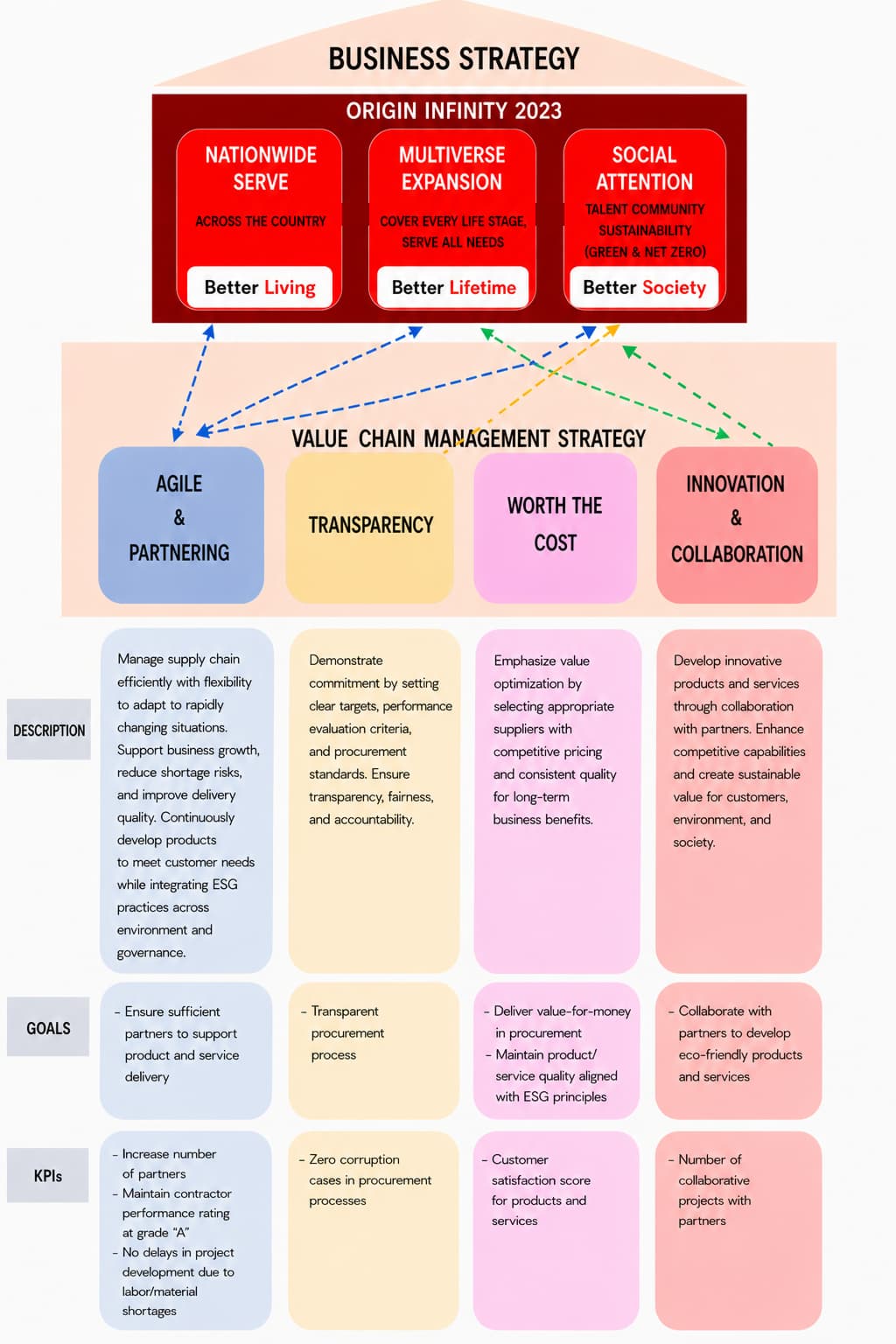
Supplier Management
Supplier Management
Origin Property Public Company Limited places importance on supply chain management not only to increase operational efficiency or prevent impacts or the reputation of the organization but to increase transparency. Suppliers therefore are stakeholders who play an important role in the sustainable operations of the Company. Therefore, supplier management to be able to deliver quality products and services based on the principles of good governance along with being responsible for the economy, society, and environment (ESG) is considered business opportunities enhancement and able to provide risk management services in the supply chain system to ensure continuous operations.
Origin Property Public Company Limited has established supplier code of conduct with the aim for suppliers to adopt it as a guideline for operating in accordance with their operations according to the supplier context with consideration to business operations that are responsible for the environment, society and good governance in order to create sustainability in doing business together
Supplier’s Code of Conduct : https://origin.co.th/wp-content/uploads/2024/05/20230118-ori-suppliers-code-of-conduct-th.pdf
Sustainable Procurement Policy: https://origin.co.th/wp-content/uploads/2025/09/Sustainable-Procurement-Policy-Sep25.pdf
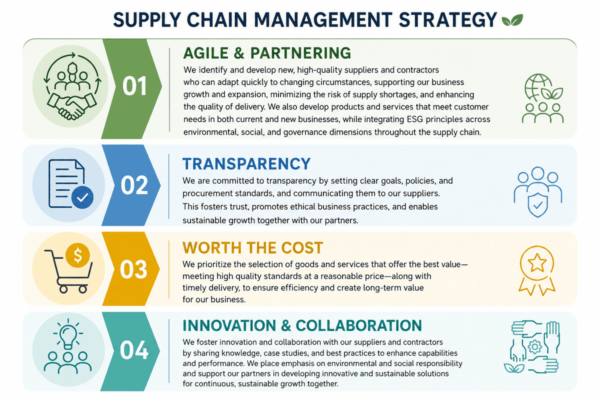
Operational process for sustainability
The Company has established sustainable supplier management guideline to increase operation efficiency and effectiveness by applying it in the Company’s internal activities in order to promote sustainable supply chain management, increase the opportunity to reduce risks, and improve business competitiveness. The process for sustainable supplier management has been established as follows:
1. Supplier recruitment and selection process: Partners must be selected based on basic qualification criteria set by the Company, such as product quality, reputation, operational expertise, work experience, and financial stability status.
2. New supplier registration: New suppliers must complete a self-assessment. The supplier assessment covers ESG risks, quality, and operations under economic, social, and environmental responsibility and must be aware of the Supplier Code of Conduct.
3. Current supplier assessment: The Company aims to develop its business to grow together with its suppliers by setting work standards, assessing the performance of suppliers and risks every 6 months, and screening suppliers in order to develop the potential of quality products and services delivered to customers in a sustainable way by considering the quality of product, delivery, and satisfaction. The Company will monitor and assess the performance of its suppliers annually and set supplier assessment guidelines before and after trading to be able to measure and grade partners in each category. The Procurement Department is assigned to evaluate the potential of suppliers before trading in order to screen out suppliers whose assessment results are below the criteria from the Approved Vendor List.
The scoring criteria and assessment results in 2025 are summarized as follows.
Score criteria | Assessment Results 2024 | Assessment Results 2025 |
Grade A: in the range of 80-100 points Good suppliers are suppliers that the Company will trade with first | 50 suppliers | 34 suppliers |
Grade B: in the range of 70-79 points | 184 suppliers | 184 suppliers |
Grade C: in the range of 60-69 points | 69 suppliers | 98 suppliers |
Grade D: in the range of 50-59 points | 10 suppliers | 5 suppliers |
Grade F: lower than 50 points Present to the Procurement Committee to request removal from AVL | 4 suppliers | 3 suppliers |
4. Supplier classification: The Company has reviewed and classified the main suppliers (Critical Tier1 Supplier) and classified the suppliers that provide products and services to the main suppliers (Critical Non-Tier 1 Supplier) with the following conditions:
Main suppliers | Conditions |
Critical Tier 1 Supplier | – Accumulated order value up to 80% – is a main component of high importance in project development – The main suppliers of the Company |
Critical Non-Tier 1 Supplier | – is a main component of high importance in project development – Size of the business: size L – The main suppliers of the Company |
This year, procurement operations performance can be summarized as follows:
Operation | Operations performance 2024 | Operations performance 2025 |
Total number of suppliers (order value) | 1,200 suppliers (4,495,729,729 Baht ) | 1,253 suppliers (5,110,223,506 Baht ) |
Number of Critical Tier 1 Supplier (order value) | 14 suppliers (2,926,733,721 Baht) | 14 suppliers (2,941,507,887.56 Baht) |
New suppliers are assessed before trading with environmental, social and governance (ESG) factors | 100% | 100% |
New suppliers must be informed of the Supplier Code of Conduct before registering in the system | 100% | 100% |
On site Survey important suppliers | 14 suppliers (Total 14 suppliers) | 14 suppliers (Total 14 suppliers) |
Assessment Results | 100% | 100% |
Suppliers shall conduct their business with integrity, transparency, and fairness in business practices. | 100% | 100% |
Suppliers shall ensure the quality of products and services provided. | 100% | 100% |
Suppliers shall prioritize occupational health and safety in their operations. | 91% | 91% |
Suppliers shall implement appropriate environmental management practices and contribute to environmental protection. | 100% | 100% |
Suppliers shall protect confidential information and respect intellectual property rights. | 100% | 100% |
Suppliers shall respect labor rights and human rights, treat workers with dignity, and ensure non-discrimination and equal opportunity. | 100% | 100% |
Suppliers shall comply with anti-corruption and anti-bribery principles in all business activities. | No risk found | No risk found |
The Company has set a target to conduct on-site ESG audits for 100% of its critical Tier 1 suppliers, totaling 14 suppliers. The Company successfully achieved this target. For 2026, the Company remains committed to maintaining 100% ESG audit coverage of all Tier 1 suppliers. The results of the on-site ESG audits demonstrate that the Company’s key suppliers have complied with the Company’s ESG standards in all aspects. Suppliers operate their businesses with integrity, transparency, and fairness, deliver products and services that meet the required quality standards, and ensure occupational health and safety for their workforce. In addition, suppliers show respect for human rights and equality, with no discrimination and full respect for human dignity. They also prioritize maintaining safe and fair working conditions that support sustainable development and strictly adhere to anti-corruption principles. Achieving a full 100% compliance rate reflects more than a performance indicator; it represents the strong collaboration between the Company and its suppliers in building a transparent, reliable, and sustainable supply chain.
Furthermore, in 2025, the Company conducted an ESG risk assessment questionnaire with its suppliers, and the results indicated that no ESG risks related to suppliers were identified, including economic, social, and governance risks.
The Company has established payment terms for trade credit ranging from 15–60 days, depending on the type of supplier. For example, small-scale contractors receive payment within 15 days, while suppliers of materials or other equipment receive payment within 30 days. In practice, the Company has maintained an average payment period of 15–45 days to its suppliers.The Company has consistently conducted supplier assessments under the Environmental, Social, and Governance (ESG) framework. The results reflect strong collaboration and shared commitment between the Company and its suppliers to uphold transparent, ethical, and sustainable business practices. Each year, all new suppliers are subject to a comprehensive screening process and are required to acknowledge and comply with the Supplier Code of Conduct before entering into a business relationship with the Company. In addition, key suppliers are regularly subject to on-site audits to ensure that operations throughout the supply chain continue to adhere to principles of good governance and transparency. The assessment results in key areas—including business integrity, product and service quality, occupational health and safety, respect for human rights, and anti-corruption practices—have consistently achieved a 100% compliance rate. In terms of compliance with environmental regulations, some areas remain under improvement, with the latest assessment score at 91%. The Company has therefore implemented follow-up actions and development plans to support suppliers in achieving full compliance in the near future. Such consistent performance not only reinforces the strength of the Company’s supply chain governance system, but also reflects the trust, confidence, and shared commitment between the Company and its suppliers in driving sustainable growth and creating value for society, the environment, and all stakeholders.
Supplier’s sustainable business operations development
The Company has implemented sustainable supplier development initiatives by establishing ESG standards, conducting supplier performance assessments and monitoring, strengthening knowledge and capabilities, and fostering incentives and strategic collaboration with suppliers. These efforts aim to enhance suppliers’ capacity and enable them to grow sustainably alongside the Company.
Performance Results
Supplier Collaboration and Structured Knowledge Exchange Program
This is achieved through knowledge exchange activities, workshops, and joint efforts to improve the quality of products and services in alignment with the Company’s standards. In addition, the program promotes higher standards in procurement practices and sustainable supply chain management. The initiative is implemented through 2 key programs as follows:
- Anti-Corruption Training Program for Suppliers
the Company encourages its suppliers to participate in the Thailand’s Private Sector Collective Action Coalition Against Corruption (CAC) initiative. This initiative aims to raise awareness of how corruption negatively impacts and obstructs the social and economic development of the country, while promoting a collective commitment to transparency and fairness within organizations. Through this initiative, the Company and its suppliers jointly demonstrate their commitment to ethical business practices and good governance. In 2025, a total of 45 supplier companies from various industries participated in the program.
- Product and Service Skills Development Program
To enhance the effectiveness of basic customer service, the Company collaborates with suppliers by inviting their experts to share knowledge and help develop the capabilities of employees. Training sessions cover key areas such as air conditioning systems, elevator systems, and construction
practices. The program also provides an opportunity to exchange feedback and insights gathered from customers, which are then used by suppliers to improve and further develop their products and services to better meet current customer needs and expectations. In 2025, the Company organized 3 knowledge exchange training programs with suppliers, with a total of 65 participants. These activities contributed to the continuous improvement and development of both products and services.
As a result of this collaboration, positive outcomes have been achieved in terms of the Company’s strategic development. Both the Company and its suppliers are able to enhance their competitiveness, build greater customer confidence, and grow together in a stable and sustainable manner. Part of the outcomes from these initiatives is evaluated through the Company’s annual on-site ESG audit, which serves as an assessment mechanism and also as one of the criteria for selecting suppliers for future collaboration. The Company places particular emphasis on working with suppliers who demonstrate strong commitment to and compliance with the Sustainable Procurement Policy, which encompasses key aspects including quality, safety, environmental management, social responsibility, and good governance (ESG).
This approach ensures consistent standards across the entire supply chain while helping to mitigate potential business risks in the long term.
Contractor Capability Development and Operational Standards Development Program to promote growth alongside the Company under the ESG framework and good governance principles, the program places strong emphasis on the implementation of a Waste Management Plan at construction sites. The Company applies the concept of Circular Economy to construction resource management by encouraging the efficient use of available materials and resources to minimize environmental impacts.This approach includes planning to reduce unnecessary resource consumption, minimizing waste generation, promoting proper waste management practices, and supporting the reuse and circulation of resources. In addition, the Company emphasizes the use of pre-fabrication construction methods, where building components are manufactured or assembled in advance. This helps reduce leftover construction materials, shorten construction time, and lower on-site operational risks. Materials that have undergone reprocessing are also reused efficiently and sustainably whenever possible.In 2025-2026, the Company set a target to minimize waste generated from construction projects while maximizing opportunities for reuse and recycling. Recovered materials are either utilized within ongoing construction projects or distributed to surrounding communities through social initiatives, thereby creating additional value for society.